
Construction management, or CM, is a way of delivering a project where the owner hires a construction manager early, during design, to advise on cost, schedule and buildability, and then to manage the trades on an open-book basis. Kay2 Commercial provides construction management in Calgary for owners and landlords whose projects are larger, phased or still changing, where seeing every trade price matters more than fixing a single number early.
How construction management works
Under construction management, the owner usually keeps their own architect or designer. The construction manager joins the team during design, prices the design as it develops, plans the schedule and the phasing, and advises on materials and methods. When the drawings are ready, the work is broken into trade packages and tendered. The owner sees every bid and every price.
During construction, the construction manager runs the site, coordinates the trades, manages the schedule and safety, and reports costs against the budget. The construction manager is paid a fee for their services, separate from the cost of the work, so their interest is in running the project well rather than in the margin on any one trade.
Construction management, design-build and general contracting
Each delivery model puts risk and control in a different place.
| Construction management | Design-build | General contracting | |
|---|---|---|---|
| Contractor joins | During design | At the start, and does the design | After the design is finished |
| Pricing | Open book, trade by trade | Develops with the design, then fixed | One stipulated price on finished drawings |
| Who carries cost risk | Mostly the owner | The design-builder, once the price is fixed | The contractor, for what is on the drawings |
| Flexibility to change scope | High | Medium | Low, through change orders |
| Best for | Large, phased or changing projects | Single units and fixed opening dates | Complete designs that must be tendered |
See design-build and our general contractor page for the other two models.
When construction management makes sense

Construction management is the better choice when:
- The project is large or phased, such as a multi-unit renovation, a building that stays open during construction, or a redevelopment in stages.
- The scope will keep developing after construction starts, for example because tenants are still being signed or funding is released in phases.
- The owner has their own architect and wants to keep direct control of the design.
- A board, lender or funding body needs to see trade-level pricing and tendering.
- Early work, such as demolition, abatement or a site-servicing package, needs to start before the whole design is finished.
For a single tenant improvement with a fixed opening date, design-build is usually simpler and faster. We will tell you which model fits.
What the construction manager does in each phase
Construction management starts during design and continues until handover.
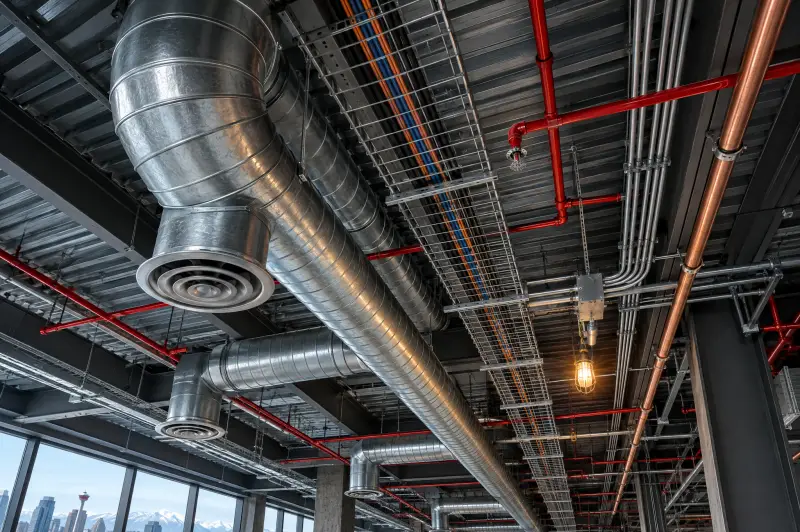
During design:
- Cost planning at each design stage, so the design stays inside the budget.
- Buildability reviews to catch details that are hard or slow to build.
- A master schedule, with phasing for occupied buildings and lead times for equipment.
- A plan for trade packages and an early-works package if needed.
During tendering:
- Pre-qualifying trades on safety record, insurance, capacity and references.
- Issuing trade packages and comparing bids line by line.
- Recommending awards for the owner's approval.
During construction:
- Site supervision, safety and coordination of the trades.
- Schedule updates and cost reports against the budget.
- Managing changes, inspections and the City of Calgary permit process.
- Commissioning, deficiencies, occupancy and handover.
Contracts, fees and payment
In Canada, construction management is commonly contracted using the CCDC 5A form, where the construction manager provides services only and the owner holds the trade contracts, or CCDC 5B, where the construction manager holds the trade contracts as well. The construction manager's fee is usually a percentage of the cost of the work or a fixed amount, plus agreed general conditions such as site supervision and temporary facilities.
Payment on Alberta projects follows the Prompt Payment and Construction Lien Act, which sets deadlines for paying proper invoices and requires a holdback of 10% of the value of the work until the lien period ends. A construction manager tracks these deadlines for every trade, which keeps the trades paid on time and the project free of liens.
Cost control and reporting
Open-book pricing only helps if the reporting is clear. We report the budget, the committed costs, the approved and pending changes, and the forecast final cost, trade by trade, at agreed intervals. Owners see where the contingency is being used and why, and decisions about scope are made with the current forecast in front of them, not at the end of the project.
Construction management questions
What is the difference between a construction manager and a general contractor?
A general contractor bids a stipulated price on finished drawings and takes the risk on that price. A construction manager joins during design, advises on cost and schedule, and manages the trades on an open-book basis for a fee. The owner sees every trade price and carries more of the cost risk.
Is construction management more expensive?
The fee is visible, which can make it look higher, but every trade is tendered and the owner sees the savings. It tends to cost less on projects where the scope changes, because changes are priced at trade cost rather than through a contractor's change orders.
Can construction management be used for a renovation in an occupied building?
Yes. It suits occupied buildings well, because the work can be phased and the trade packages planned around tenants and building hours. See our commercial renovation page.
Do I need my own architect for construction management?
Usually, yes. Under construction management the owner normally contracts the architect or designer directly. If you would rather have one contract for design and construction, design-build is the better fit.
When should a construction manager be hired?
As early in design as possible. Most of the value of construction management comes from cost and buildability advice before the design is fixed.